
A Million Dollars Is a Math Problem
Everyone who doesn't have money says they want a million dollars. So I ran the math. The numbers work fine. That was never the hard part.
Everyone who doesn't have money says they want a million dollars.
It's the default answer. The round number you pull out of the air because it sounds like enough. Like made it. Like I don't have to think about this anymore.
So I ran the math. Not because I have it figured out. Because I wanted to see what the dream looks like as a spreadsheet.
The Whole Thing Is One Equation
Price times volume equals revenue. That's it. That's every business model there is.
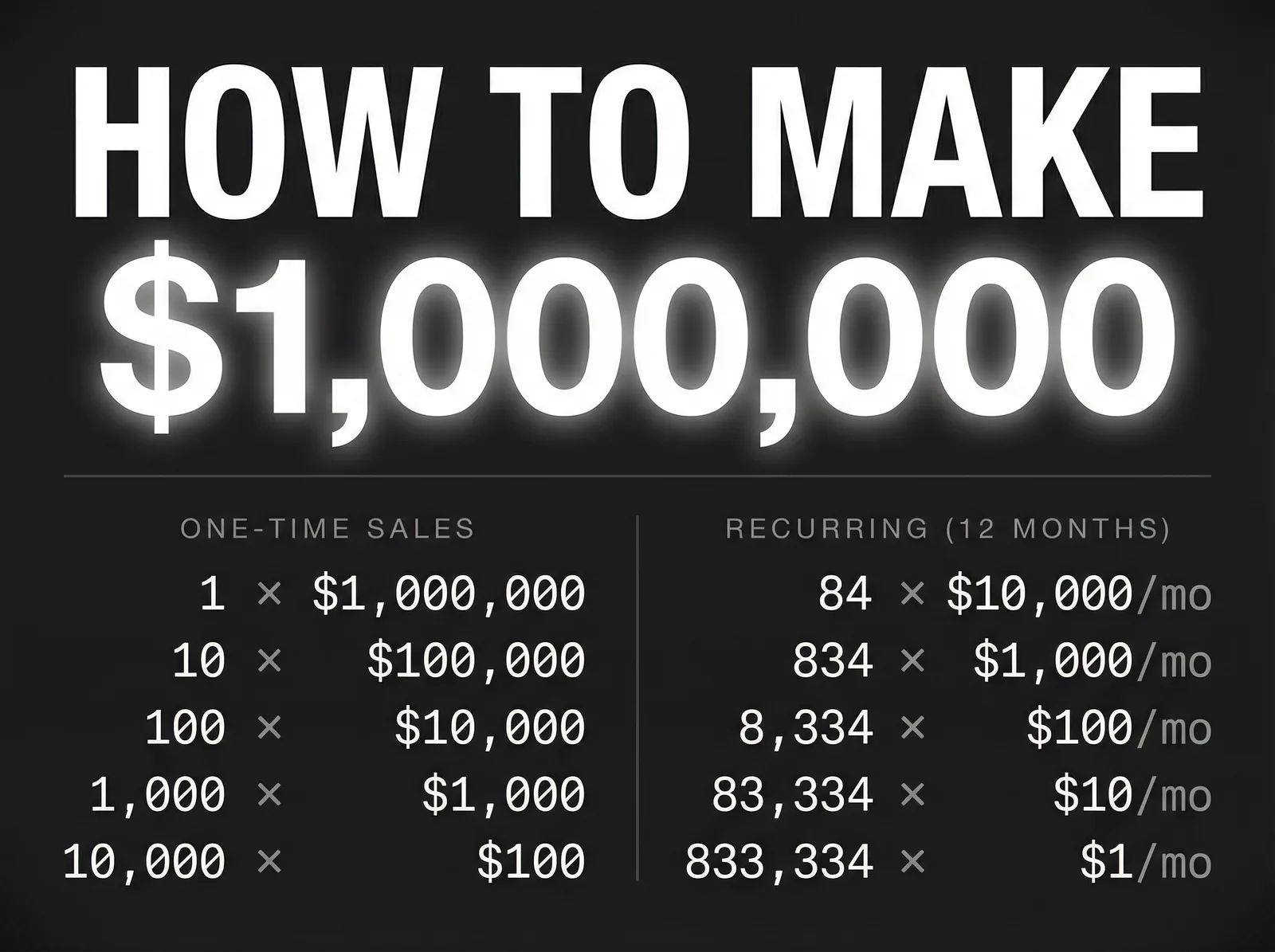
Here's what a million dollars looks like from both sides.
| One-time sales | Recurring, over 12 months |
|---|---|
| 1 × $1,000,000 | 84 × $10,000/mo |
| 10 × $100,000 | 834 × $1,000/mo |
| 100 × $10,000 | 8,334 × $100/mo |
| 1,000 × $1,000 | 83,334 × $10/mo |
| 10,000 × $100 | 833,334 × $1/mo |
Same number. Completely different lives.
Selling one thing for a million dollars and selling a million things for a dollar are both "a million dollars." They require different skills, different systems, and different tolerances for pain.
Pick a row. That's your business model.
What Each Row Actually Costs You
$100,000 × 10. You need ten clients who trust you with six figures. That trust takes years. You're selling transformation, not deliverables. Realistically three to five years before you can close at this level consistently.
$10,000 × 100. The sweet spot for serious service businesses. Close two a month and that's $240,000 a year, so roughly four years to a million. But a hundred projects means a hundred relationships, a hundred scopes, a hundred invoices. The math is simple. The logistics are not.
$1,000 × 1,000. Digital products, courses, workshops. A thousand sales. At a 2% conversion rate you need 50,000 people to see the offer. Where do they come from? Probably one to two years of publishing before you have an audience big enough to try.
$100/mo × 834 subscribers. This is the one that compounds. Year two and year three build on the year before instead of resetting to zero. But at 5% monthly churn you lose about 42 people every month just standing still. Churn is the tax nobody puts on the vision board.
$10/mo × 83,334 subscribers. Volume play. Easy yes, enormous audience required. At this point you're not building a product. You're building a media company.
Every row works on paper. None of them are easy in practice.
What the Spreadsheet Doesn't Have a Column For
The equations are correct. The arithmetic always checks out. That's the problem with it as a plan.
There's no column for:
The Question the Math Actually Changes
"A million dollars" is so vague it paralyzes you. It floats in aspirational fog where it feels impossibly far and somehow inevitable at the same time, and neither of those is useful.
Break it into a hundred projects, or 834 subscribers, or ten thousand sales, and it stops being a dream. It becomes a task list. A long one that's boring in the middle. But a list.
And then the question changes. It isn't how do I make a million dollars.
That's a much better question, because every row is a different life. Different work, different problems, a different version of you on the other side of it.
I'm still picking mine. But I'd rather be running numbers than daydreaming about one I pulled out of the air.
> More from the Index
All posts →


> Get posts like this
Keep the thread going.
New pieces land here first. No schedule, no noise, just the ideas worth the room in your inbox.
- Essays on attention, craft, and building
- What I got wrong, with the receipts
- The occasional teardown of something I built
Unsubscribe anytime · No spam
.gif)
> ReturnSend
Subscribe Now.
Wake up curious. The work, the art, and the ideas underneath. Occasional, personal, and only when there's something worth sending.